
Most destinations have a logo. Some have a tagline. A few have a brand guide. Almost none have a brand framework.
The difference matters. A logo is a mark. A tagline is a line. A brand guide tells you what font to use and what colors to avoid. A brand framework tells you what the destination stands for, who it is for, why those people should choose it over every alternative, and how every touchpoint from a paid media post to a trade show booth to a Copa Airlines livery should express that answer consistently.
Without a framework, every agency, partner, and market office interprets the brand independently. The destination splinters. It says different things in different markets to different audiences through different creative executions, none of which build on each other. The investment accumulates but the brand does not compound.
In 2021, PROMTUR Panama built Panama's first unified national destination brand from the ground up. This article explains the architecture of that framework, how it was built, and what it took to deploy it across a national marketing program, industry partners, airline alliances, and international trade channels.
Without a framework, every agency and partner interprets the brand independently. The destination splinters. The investment accumulates but the brand does not compound.
Why Most Destination Brands Do Not Hold
A destination brand fails to hold for one of three reasons. The first is that it was never defined at sufficient depth. A positioning statement and a color palette are not a brand. They are surface elements. Without the underlying architecture, there is nothing to hold the surface in place when execution decisions are made under pressure.
The second reason is that the brand was defined but not operationalized. The strategy document exists. The agency presentation was approved. Then the organization returned to business as usual and the brand lived in a PDF. Nobody trained the industry on it. Nobody built the creative toolkit that made it easy for partners to use. Nobody enforced it when it was ignored.
The third reason is that the brand was defined for the organization, not for the traveler. It reflected what the destination wanted to say about itself rather than what the target traveler needed to hear to choose it. A destination brand built on internal consensus produces creative that the board approves and the traveler ignores.
The Architecture: Seven Layers
A destination brand framework is a hierarchy. Each layer informs the one below it. The layers at the top are strategic and change rarely. The layers at the bottom are executional and change constantly. The framework holds when every executional decision can be traced back to a strategic layer and justified by it.
The non-negotiable truths about the destination. Not aspirations. Not what the destination wants to become. What it already is, at its core, that no competitor can authentically claim. Brand DNA is derived from the destination's history, geography, culture, and community. For Panama, the DNA was rooted in the country's position as a crossroads of the world: two oceans, two continents, a canal that connects global trade, a culture shaped by seven officially recognized indigenous peoples including the Guna, Emberá, Ngäbe, and Wounaan, Spanish colonial history, and a metropolitan financial center sitting alongside some of the most biodiverse ecosystems on earth. That is not a marketing claim. It is a geographic and cultural fact. The brand builds from there.
What the destination commits to delivering to every visitor. Not a tagline. A commitment that the entire destination, from the airport to the hotel to the tour operator, is accountable for keeping. Panama's brand promise was "Radiating with Life." It captured the energy, biodiversity, and human warmth that define the destination experience across every segment and every itinerary. It also set a standard: if an experience does not radiate with life, it is off-brand.
The single most defining characteristic of the destination's personality. The word or phrase that, if the destination were a person, would describe how they move through the world. Panama's brand essence was "Refreshingly Irreverent." It captured the destination's refusal to conform to the expected Central American tourism script, its mix of the sophisticated and the raw, the cosmopolitan and the indigenous, the engineered and the wild. It was also a strategic signal to the creative team: the brand should surprise, not reassure.
The competitive claim. The single statement that answers: why Panama over every alternative destination in the consideration set? Panama's positioning was "Where Worlds Converge." It was both literally true, two oceans, two continents, a canal, and seven distinct indigenous peoples, and competitively distinct. No destination in Panama's direct competitive set could make the same claim with the same credibility. Positioning is not a tagline. It is the strategic answer to the competitive question that every other brand element is designed to support.
The activation idea that translates the positioning into a program. Panama's brand platform was "Live for More." It operationalized "Where Worlds Converge" into a traveler proposition: this is the destination where you do not just visit, you expand. You experience more, feel more, discover more. "Live for More" became the organizing principle for all content, all creative, all channel strategy, and all partner co-branding. It was the platform under which every itinerary, every media placement, and every trade presentation operated.
The platform worked because it carried three distinct and simultaneous meanings, each true for a different audience.
For the Panamanian people, "Live for More" expressed the national character: a relentless drive for progress, ambition, and forward momentum. It was not borrowed aspiration. It reflected something already present in the culture.
For Panama as a place, it spoke to the country's extraordinary abundance: two oceans, two continents, extraordinary biodiversity, a canal that connects the world, a cosmopolitan capital, and some of the most biodiverse ecosystems on earth. Panama is not a destination of scarcity. It is a destination of convergence and surplus.
For the international traveler, "Live for More" spoke directly to the motivation that drives the destination's priority audience: discovery, personal growth, and the desire to experience something that expands rather than simply entertains. The Creative Idealist, the History Seeker, and the Holiday Globetrotter all heard the same invitation and understood it through their own lens.
A brand platform that means something different and true to each of its constituencies is rare. Most platforms are written for one audience and tolerated by the rest. "Live for More" was genuinely multi-audience without being vague.
The visual mark was not designed independently of the brand strategy. It was designed to express it.
At the center of the logo is the tilde over the á in Panamá. In Spanish, the tilde carries emphasis. In the brand, it was given a second role: the tilde becomes a burst of energy, a visual expression of the brand promise "Radiating with Life." The accent mark does not just indicate pronunciation. It releases energy.
That burst of tildes expands outward to represent the kaleidoscope of intersecting identities, colors, sounds, and cultures that converge in Panama. The visual metaphor connects directly to the positioning, "Where Worlds Converge," without stating it.
The color system used the blue and red of the Panamanian flag. That choice was both strategic and competitive. Panama's direct competitors in the Latin American destination set used greens, yellows, and earth tones. The flag colors distinguished the brand immediately on any shared media surface while anchoring it in national pride and identity.
The result was a logo where every element, the tilde, the burst, the color, the typography, traced back to either the brand promise, the positioning, or the national identity. It was not decoration. It was the brand architecture made visible.
The psychographic segmentation that defines who the brand is speaking to. Not demographics. Psychographics: values, travel motivations, decision-making patterns, and content consumption behaviors. Panama's audience architecture identified three primary segments drawn from a global consumer segmentation study across 19 source markets.
The graphic language that expresses the brand across every touchpoint. Color, typography, photography style, motion principles, layout systems. The visual identity was designed to be distinctive within the Latin American destination competitive set and flexible enough to work across digital, print, trade, and co-branded partner environments. It was also designed to be ownable by industry partners: hotels, tour operators, and airlines could use it without diluting it.
The Audience Architecture: Three Segments
Psychographic segmentation is the mechanism that prevents a destination brand from trying to speak to everyone and connecting with no one. Panama's three segments were defined by travel motivation and value alignment, not by age or income. Each segment had a distinct itinerary, distinct content casting, distinct channel strategy, and distinct creative treatment, all operating under the single "Live for More" platform.
Motivation: Discovery, culture, sustainability, authentic human connection.
Itinerary: The complete Panama experience. Gamboa Rainforest Reserve, Emberá indigenous community, Casco Viejo, Panama Canal.
Channel emphasis: Long-form content, editorial, cultural publications, sustainability-aligned media.
Motivation: Adventure, nature, active experiences, off-the-beaten-path discovery.
Itinerary: Panama fun and adventure. Sloth Sanctuary in Gamboa, Barú Volcano, Geisha Coffee Farms, Bocas del Toro, Isla Bastimentos National Marine Park.
Channel emphasis: Social video, adventure travel platforms, outdoor media.
Motivation: Culture, heritage, intellectual depth, sustainability awareness.
Itinerary: Arts and culture across Panama. San Lorenzo UNESCO World Heritage Site, eco-kayaking on the Canal Watershed, Guna indigenous community, food tour of diverse Panamanian cuisine.
Channel emphasis: Cultural and heritage media, travel journalism, documentary-style content.
Each segment had its own cast, selected to match the demographic and psychographic profile of the target audience in each source market. Content was captured specifically for each segment and then edited and adapted for each target's primary content consumption channels. The three streams shared a visual language and a brand platform. They did not share creative executions.
Psychographic segmentation prevents a destination brand from trying to speak to everyone and connecting with no one. Three segments, one platform, zero shared creative executions.
Deployment: From Framework to Program
A brand framework is only as valuable as its deployment. The Panama framework was deployed across four channels simultaneously.
Owned and paid media. The Live for More platform launched across digital channels in 2021 with three distinct content streams, one per segment. Paid media ran across YouTube, connected television, programmatic display, social media, and paid search. Each channel received creative adapted to its format and audience behavior, all traceable to the brand architecture.
Strategic alliances. The brand was co-deployed across a broad alliance network covering airlines, online travel agencies, and bed banks. Airline partners included Copa Airlines, whose co-branded aircraft livery placed the Panama brand across its full route network. OTA partners included Expedia, eDreams, and additional online travel platforms, placing branded content at the point of booking consideration and reaching travelers already in the planning phase. Bed bank partners including Hotelbeds extended brand reach through wholesale distribution channels that feed hotels across multiple source markets. Each alliance required a brand governance protocol: what the partner could use, how they could use it, and what approval was required for co-branded materials.
Industry adoption. The brand was not PROMTUR's alone. The goal was for hotels, tour operators, attractions, and airlines operating in Panama to adopt it as their own. PROMTUR ran industry training sessions on the brand framework. After completing training, partners were licensed to use the brand mark in their own marketing and advertising. That licensing model transformed the brand from a DMO program into a destination asset. Industry partners became brand ambassadors with a stake in the framework's consistency.
Travel trade and MICE. The brand was adapted for travel trade and meetings industry contexts. Trade materials, MICE bid documents, and sales presentations were developed under the Live for More platform, ensuring consistency between the consumer-facing brand and the B2B channels that drive group and convention business.
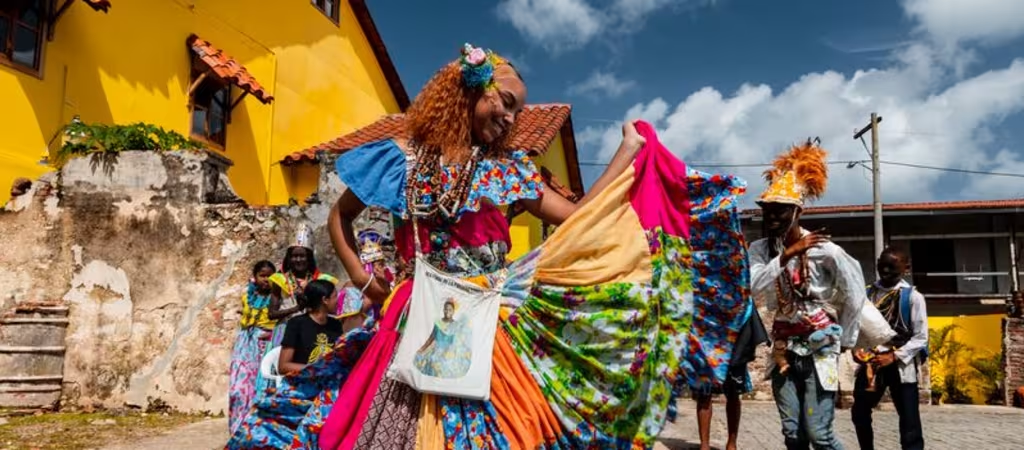
Brand consistency across trade, alliance, and partner channels requires a governance protocol, not just a brand guide.
What Makes a Destination Brand Hold
Three things determine whether a destination brand holds over time.
Depth of definition. Surface brands break under execution pressure. When a market office needs to adapt creative for a local media format, or a trade partner needs to co-brand a campaign, or an airline needs a livery concept in six weeks, the brand needs enough architecture underneath it to guide those decisions without requiring a brand review meeting. The seven-layer framework provides that architecture. Each decision can be checked against it.
Industry ownership. A brand that only the DMO uses is a marketing program. A brand that the industry adopts is a destination asset. The licensing model, training, and governance protocol that PROMTUR built turned the Panama brand from the former into the latter. Hotels that trained on the brand and earned the right to use the mark had a commercial reason to protect it. That commercial alignment is more durable than any brand compliance policy.
Measurement. Brand performance needs to be tracked with the same rigor as economic performance. Before the strategy was set, PROMTUR commissioned a baseline study across priority source markets. Panama ranked fifth in its competitive set. That baseline became the starting point for a measurable commitment: reach fourth consistently by year four. The brand tracking used a composite index measuring unaided awareness, share of mind, aided awareness, and travel intent, weighted and scored against the same competitive set every quarter. Moving brand position is slow. Displacing a competitor like Colombia does not happen in one year. Setting the target before the program launched, and tracking against it continuously, meant the organization could demonstrate progress even before the final position was reached. The brand framework was not just creative strategy. It was a measurable commitment to a defined competitive outcome.
Frequently Asked Questions
What is a destination brand framework?
A destination brand framework is a seven-layer architecture defining what the destination stands for, who it is for, why travelers should choose it, and how every touchpoint should express that answer consistently. The seven layers are brand DNA, brand promise, brand essence, positioning, brand platform, audience architecture, and visual identity system. Without this framework, every agency, partner, and market office interprets the brand independently and the destination splinters.
What is the difference between brand positioning and a brand platform?
Positioning is the competitive claim that answers why travelers should choose this destination over every alternative. Panama's positioning was "Where Worlds Converge." A brand platform is the activation idea that translates the positioning into a program. Panama's platform was "Live for More," which worked on three levels: Panamanian national character, the country's convergence and abundance, and the traveler's desire for discovery and growth. Positioning is strategic and rarely changes. The platform brings it to life across channels and markets.
What is psychographic segmentation in destination marketing?
Psychographic segmentation defines target audiences by travel motivations and values rather than demographics. Panama's program identified three segments: Creative Idealists motivated by culture and sustainability, Holiday Globetrotters motivated by adventure and nature, and History Seekers motivated by heritage and cultural depth. Each had distinct itineraries, content casting, and channel strategies, all under the single Live for More platform.
How do you deploy a destination brand across industry partners?
PROMTUR Panama built an industry licensing model: hotels, tour operators, attractions, and airlines completed brand training and were then licensed to use the Panama brand mark. Alliance partners including Copa Airlines, Expedia, eDreams, and Hotelbeds each operated under a brand governance protocol. This transformed the brand from a DMO program into a destination asset with commercial stakeholders invested in its consistency.
How do you measure destination brand performance?
Brand performance requires a composite tracking index measuring unaided awareness, share of mind, aided awareness, and travel intent across priority source markets, tracked against the same competitive set every quarter. The baseline study must come before the strategy is set. Panama established its position as fifth in its competitive set at launch and set a four-year target of fourth. The target was achieved ahead of schedule.
Related reading: Connecting a USD 22M Promotional Investment to USD 1.8B in Economic Impact and DMO Formation from Zero: Six Decisions That Determine Whether It Works.
Work with us
Building a destination brand or rebuilding one?
Oldford Global works with governments, DMOs, and destination organizations on brand architecture, audience segmentation, visual identity systems, and deployment programs that generate lasting social, environmental, and economic impact. If you are starting from zero or working with a brand that has lost coherence, start with a conversation.
Start a conversationSources & Notes
Panama Brand Blueprint, Final 2021: author's professional practice as Chief Marketing Officer and Chief Strategy Officer, PROMTUR Panama. Woodrow Oldford is credited on page 3 of the document as CMO and author of the brand vision.
Live for More Marketing Program, August 2023: PROMTUR Panama and Beautiful Star. Source market data, audience segmentation, channel mix, and influencer model drawn from program documentation.
Brand tracking methodology: Wisesense. Brand performance index based on unaided awareness (top of mind 55%, share of mind 15%), aided awareness (10%), and travel intent (20%) across priority source markets.
Competitive set: Honduras, Nicaragua, Colombia, Belice, Costa Rica, República Dominicana.